
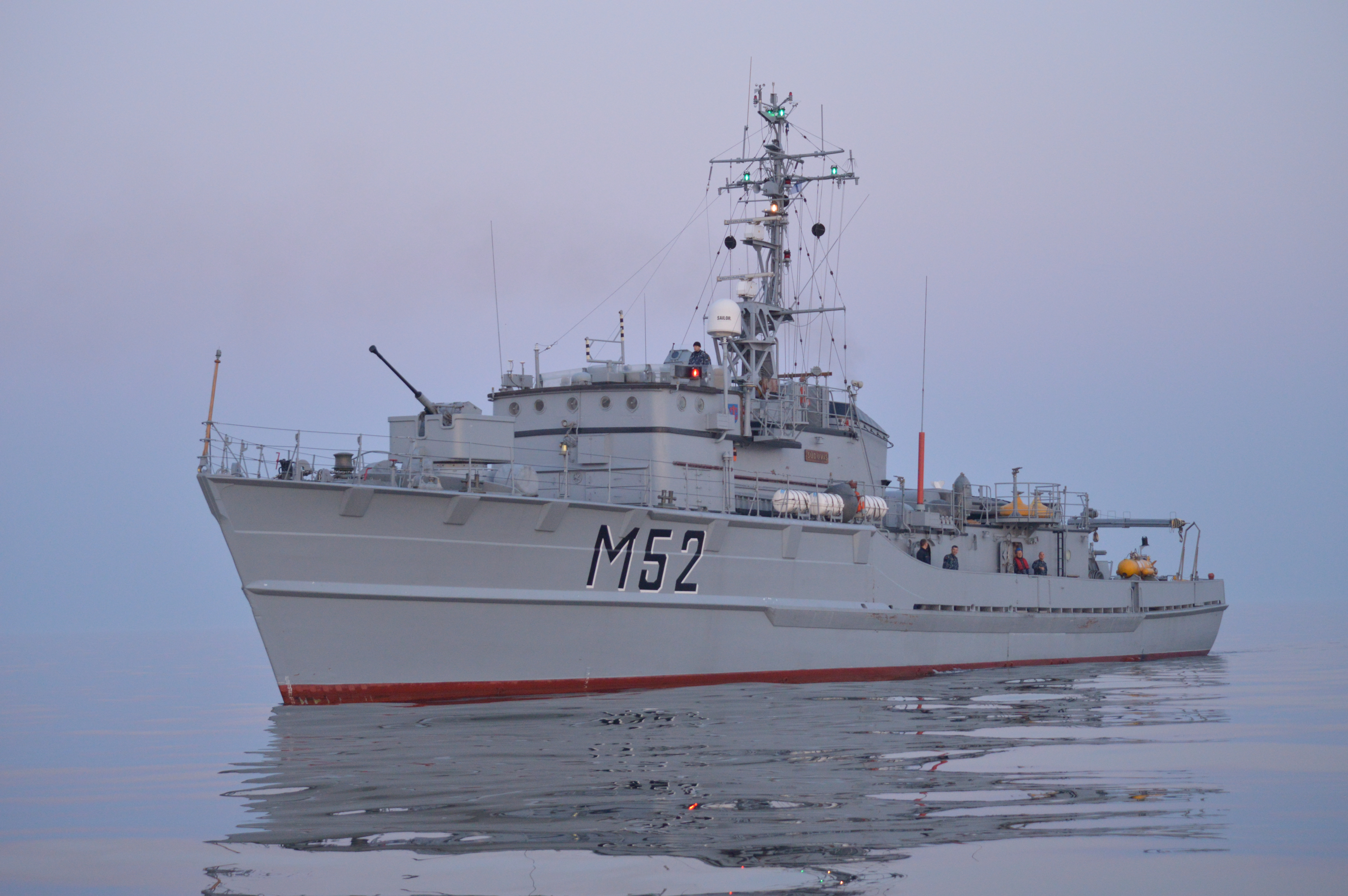
SHIP: The boat deck is a space on board above the main deck, where ship’s two boats are waiting for their tasks at sea. At both sideboards, machinegun sites are ready to meet the exercise actions. After returning to the shore, the weapons quietly return to the safe arsenal of the ship. The ventilation shaft next to the funnel is the flow of life that cools down powerful engines below, maintaining the energy and rhythm of the ship, even when the sea boils because of the challenges.
SIGNALMAN (SOUNDMAN): Here we are.
SHIP: The Baltic Sea, though relatively small and shallow, has always been an attracting strategic place. Many different subjects mined its waters to block enemy ships, thus preventing their navigation. Its waters are still hiding many mines. The de-mining operations will be performed here for several more decades. I was here, with my crew, protecting this sea, cleaning the seaways.
COMMANDER OF THE SHIP: Many things happened during the sea voyages – joy, anxiety and challenges alike.
SYSTEM ENGINEER: And, of course, sea-sickness is an unavoidable companion.
ARTILLERIST: And also the longing. Longing for family and relatives, when ceaseless waves are all around and the shores seem to be so distant.
COMMANDER OF THE ELECTROMECHANICAL COMBAT UNIT 2: Due to constant breakdowns, the service of “Sūduvis” was terminated. However, she was not destroyed – the ship was handed over to the Lithuanian Sea Museum, and her history continues.
CHIEF SUPPLY CHAIN OFFICER: I am happy to contribute to the preservation of the history of “Sūduvis”. This is our history. I dream of a day when I will visit this site with my grandchildren and show them, “I was here, I was part of this.” I want the ship to live on to allow future generations enjoy her.
COMMANDER OF THE SHIP: We will never forget how our “Sūduvis” was talking to us surrounded by the sea waves. She was narrating her saga of the sea – a strong, unbreakable, just like her crew. The Captain Lieutenant Vytautas Šakalis once said, “Sūduvis” would never pass through the degaussing of the ship because her crew was made of iron.” And it was this crew, its strength and determination that was the true engine of the ship.
SHIP: Perhaps I may not navigate anymore, but my soul – this iron link to the crew – will remain forever. And even when my hull will be standing still, I will be here, reminding of those years at sea, of those who navigated with me through the waves and storms.
SHIP: My service is over.
In 2021, the ship ended her service and was handed over to the Lithuanian Sea Museum, which, after adjusting the ship to museum and educational activities, invites the general public to explore the history of the ship and the crew. For every visitor, it is a unique opportunity to think about the value of the maritime state and remember that the maritime culture is an integral part of us.
Creative team of the project:
Mindaugas Žvirgždys (author of the concept and text)
Virginija Rimkaitė (author of the script)
Kristijonas Lučinskas (composer, sound engineer)
Mikalojus Urbonas (voice of the protagonist)
Vitalijus Aleksandravičius (chief supply chain officer – ship’s boatswain)
Andrius Kiela (systems engineer)
Darius Auškelis (chief systems engineer)
Justas Žaglinskis (chief of the electromechanical combat unit 1)
Tomas Abromavičius (chief of the electromechanical combat unit 2)
Edgaras Padimanskas (cook)
Rimantas Preimantas (Commander of the ship)
Andrius Galdikas (soundman and chief signalman)
Andrius Riauka (chief wheelman navigator)
Marius Safonovas (artillerist)
Dainius Jurevičius (diver)
SHIP: The bridge is the highest position on one of the ship’s decks, where the officer of the watch and the signalman normally carry out the sea watch. This deck housed the navigational devices and equipment, the gun sighting column and service workplaces for the staff of the bridge.
COMMANDER OF THE SHIP: The bridge on Lindau-class ships has been upgraded to an open bridge. For a sailor, the open deck is the place where man and sea meet. Here, the evening breeze caresses the cheeks and the challenges of day, night, rain and snow become a daily routine. A sailor not only watches the navigational devices, but also experiences the true spirit of the maritime lifestyle. Every moment on the bridge, watching the rudder angle or adjusting the fire reminds us that the sea is not only intimidating, but also gently embracing with its constant challenges.
SHIP: There were also many unwritten traditions on board, which strengthened the crew’s bonds and created a unique spirit. One tradition was related to bridges. You see a bridge in front of you. If a train, ambulance or other special services vehicle happened to pass when navigating under the bridge, the officer on duty owed the crew a debt of something symbolical. (Pause) Oh, are you lucky or are you in debt while you’re standing here? A small tradition that reminded us that even in a world of strict duties there is room for surprises and brotherly laughter.
Background sound: calls on someone of the crew members, “Chief signalman, stand by for the watch. I repeat: Chief signalman, stand by.”
CHIEF SIGNALMAN (SOUNDMAN): Standing on the bridge, the signalman becomes the sea watchman, alertly watching the horizon day and night. I watch the ships, I see how they are receding or approaching, looking for indistinguishable obstacles that can hide beyond the reach of the radar. I am like a link with the past, when the first sailors did not have any radars and relied only on their own eyes and instincts. The signalman not only looks at the sea, but also talks to it – using the Morse Code, light signals, flags which must always be prepared, clean and ready to send the message.
Background sound: “Your watch is over.”
SHIP: When mine-hunting at night, all the outer lights were turned off and only the main green lights on the ship’s mast and sides were on. Other vessels could already see and understand that this ship is performing the mine-hunting function, so one must keep a safe distance or, if necessary, to circumnavigate this ship.
SHIP: The foredeck of the ship is a special space. There is a 40 mm calibre BOFORS gun that protects the ship and its crew. Next to the gun is a capstan ready to drop an anchor at any moment. Foredeck is the place of the entire crew, where the sailors line-up standing shoulder to shoulder, looking at the horizon and waiting for new challenges. It is a place where strength merges with the spirit of the community, where every sailor feels being connected to the ship, the sea and his comrades-in-arms.
Background sound: invites one of the crew members “Artillerist, stand by for the work with the naval gun. I repeat: Artillerist, stand by to work.”
ARTILLERIST: I am Marius Safonovas, an artillerist. Born and raised in Klaipėda, connected with the sea since childhood. My father was a sailor, so this connection naturally was passed to me. Although I dreamed of becoming a sailor, I chose the path of a military officer and I never regretted it – the sea was always close to me. I became part of the naval family while looking at warships passing by in the port. After the compulsory military service, even though serving in the land forces, I finally fulfilled my desire to become a naval seaman. It was a definite influence of the port, ships and maritime feeling that attracted me so much since my early age.
My career began in 2008, when I was appointed to the ship “Sūduvis” for the position of an artillerist. My duty was to take care of the naval gun: maintenance, operation and control under various conditions. The control of the naval gun Bofors l70 became my passion. Although it was a technical job, it had its charm – it was interesting to shoot, and every shot required much focus and experience. I remember we participated in the exercise and destroyed the imitation of a wooden boat, my commander unexpectedly put the projectile’s splinter with a wooden fragment in a frame – I still keep this gift as a special piece of memory.
My career began in 2008 and ended in 2019 – I spent all these eleven years serving on board “Sūduvis”. My last mission on board this vessel was also the last voyage in the naval ship’s history. After the exercise in Tallinn, the ship was prepared for decommissioning and we, her crew, were appointed to other ships. These eleven years have become not only a part of my service, but also an important part of my life’s story.
Background sound: “Your service is over.”
SHIP: After the artillery shooting, the commander would play loud rock music recordings on board. This was the effort to raise the combat spirit of the crew. We also had our brand song and played loudly through the speakers when leaving the last port. The most popular was a Lithuanian song “The Long Road”. Whereas the choice of songs when leaving Klaipėda port varied depending on the mood of that day. For example, the crew often would sing a popular Lithuanian song with the adapted verse “A Seagull Is Waving Me with Its Foot”. For me, these were the funniest moments.
Background sound: invites one of the crew members “Divers, stand by for the work. I repeat: divers, stand by.”
DIVER: I am Dainius Jurevičius, a diver. My job is related to the secrets of the depth. When submerging into the water, I feel the world around me is slowing down. Everything takes a different rhythm underwater – time here is passing slowly, every movement is important, every breath is delicate. My task is to inspect the ship, to check her condition, and I take care of the ship. I dive to the seabed before the de-mining, where human’s eyes don’t see, my hands become my eyes, touching the seabed, trying to identify its characteristics – clayey, hard, stony or smooth.
When we are preparing for the mine detonation, I slide quietly through the water, knowing that safety not only of the entire crew, but also of myself is in my hands. The cold and darkness of the water are not enemies – they become my allies helping to perform a duty. There is no place for fear or doubt underwater, only confidence in myself and my team. Every moment underwater is a dialogue with the nature’s element that hides the secrets of the sea and our strength.
Background sound: “Your duty was completed.”
SHIP: The wheelhouse is the heart of the ship where four soldiers operate the ship from the upper combat post. Here, the operator of the VPP (variable pitch propeller), the wheelman, the radar operator and the signalman work in shifts to continuously operate the ship at sea. The VPP operator adjusts the angle of the propeller blades to control speed and manoeuvrability. The use of the electric gear allows the vessel to move more quietly and economically, reducing fuel consumption and vibration, particularly important during mine hunting.
CHIEF HELMSMAN NAVIGATOR: I am Andrius Riauka. From 2004 to 2007, I was the chief of the team of helmsmen navigators. A helmsman is a soldier who monitors the rudders of a ship, steering the ship on her intended course. He does not have to look behind the porthole, as his main objective is to stay on course. The officer of the watch gives the direction, and the helmsman carries out the instructions with precision. The radio positioning system – the radar – monitors the surroundings, displaying the nearest objects. This system allows the officer of the watch to see the overall situation, identify vessels or other objects, ensure safe passage and avoid accidents.
I have always dreamt of becoming a sailor. Since childhood, I was attracted to the sea, so after graduating from the lower secondary school I entered Klaipėda Shipping School, where I studied between 1992 and 1996. After my studies, I had to carry out practical placement in the civil fleet, but there were not enough vacancies, so I was called up for compulsory service in the navy. I was so engaged in there – the naval service was really attractive. After four months of compulsory service, I was offered to stay on, and I accepted this offer without hesitation.
SHIP: The navigation room is where vital devices are located: the GPS system which accurately identifies the coordinates of the ship, the acoustic depth finder which measures depth, the speed log observing speed and the gyro compass which indicates direction. This is where the technologies allowing the ship navigate safely anywhere in the world meet.
COMMANDER OF THE SHIP: The radio room is the place where communication between ships and coast radio stations is established. This is where messages are transmitted orally or in writing, securely and confidentially. Access to this area is restricted to those with a security clearance and is approved by the ship’s commander.
SHIP: We are in the central control room – the place where mine hunting is led at sea. The mine-hunting is commanded by a minehunter, while two soldiers focusing on a console accurately monitor the seabed for abandoned mines, bombs or other dangerous finds. When a suspicious object is detected, the commander decides whether to send the robot to the depths. On watch, the officer monitors navigation of the ship, direction of wind and currents of water. He communicates with other ships, and the soldiers mark on a computer screen the underwater objects they find. During the four-hour watch, the watch rotates – some go to rest, others continue to hunt for the hidden secrets of the sea.
Background sound: calls one of the crew members “Prepare the starboard robot for launching; soundman, stand by. Repeat: “Soundman, stand by.”
SOUNDMAN: My name is Andrius Galdikas. I served on board from 2008 until the last days of the ship’s service. I started as a soundman, then I became a chief of the signalling team. The job of a soundman is to take care of PAP 104 underwater robots. I supervised, charged and prepared them for work according to a strict schedule.
SOUNDMAN: Mine-hunting has not always been successful. Sometimes you spend days watching the sonar screen, trying to identify whether the objects underwater are mines or just stones. It’s a test of patience. The sonar is our eyes in the depths of the sea, but it is only when a potential mine appears on the screen and the mood of the crew changes completely. The real action begins. The greatest reward is when we find a mine and successfully detonate it. Such moments would be remembered by the entire crew as a victory.
Background sound: “Your mission is completed.”
SHIP: People think that the sea is clean, that there is nothing left. During the First and Second World Wars, around 170,000 mines or other explosive devices were installed in the Baltic Sea. Although a lot of clean-up work has been done to make ships and people feel safe, to this day, large quantities of explosives remain in the sea and pose a danger.
SHIP: Let’s move on to the next combat station.
SHIP: The main corridor in front of you is the ship’s artery, connecting the ship’s spaces. From here you can access the living quarter, cabins, washrooms, the sonar room and the provisioning room, even the crew’s quarters on the lower decks. In the corridor, there is a wooden cabinet – the arsenal – where machine-guns, pistols, flares and cartridges are stored. Next to it, is the firefighters’ equipment: breathing air cylinders, fire extinguishers and fireproof suits. When the ship enters the vastness of the sea, it is here, in the corridor, that the crew is set to watch on duty, prepare for the challenge.
SHIP: To the right, there is a quarter for non-commissioned officers, an oasis of calm where senior sergeants and non-commissioned officers can escape the routine of the ship for a short time, have a cup of coffee and relax. During the day, according to the ship’s schedule, crew members gather here for short breaks. But when the mine-hunting starts, this room becomes a safe haven – the crew stay here for safety reasons, staying above the waterline and prepared for any unexpected course of events.
SHIP: Next to the non-commissioned officers’ mess room, is the officers’ mess room, where the spirit of the ship pervaded. Officers used to gather here for recreation, but one rule was unbreakable – nobody dared to sit on the ship commander’s seat. Officers, warrant officers, other sailors – all had their own space, but the commander’s seat was special. If anyone forgot this unwritten rule and dared to sit down, they would not only blush in shame, but they would also face punishment devised by the crew. The ship commander’s seat was a reminder to all of us of the respect and order on board.
SHIP: The ship hides inside much more than just mechanics – every corner of her has its own special purpose. Take the ABC room, for instance. On a daily basis, it is simply a place for officers’ hygiene, but in the event of a threat, it becomes a filter through which every crew member passes when returning to the ship after coming into contact with a nuclear, biological or chemical weapon. First, individualised cleaning and decontamination with powder, then a shower. Only then the soldier may return to the safe haven of the ship.
COMMANDER OF THE SHIP: Each commander of the ship had his own single cabin, and when I, Rimantas Preimantas, was serving on “Sūduvis” from 2005 to 2014, my cabin’s door was always open. Whether a soldier wanted to talk about personal concerns or had service matters to deal with, the door was never closed. After all, a commander needs not only to lead, but also to hear.
The burden of being in command of the ship is heavy because you are responsible for everything: the crew, the safety of the ship, the armaments. A single commander is unable to control everything, there are officers around, but the final decision falls on my shoulders.
My story began far from the sea. I was born in Baisogala, Radviliškis District, a small town, about 200 kilometres from the sea. Earlier, I have only seen the sea during short summers, once a year. But everything changed at school, in the last, 12th, form, when my father noticed an advertisement in a newspaper inviting young people to apply to the German Naval Academy. I was learning the German language at school, so I decided to give it a try. The sea seemed a world away, but, as they say, one’s appetite increases while eating. I entered, and the life became inseparable from waves and winds.
Studying in Germany was not easy. I failed at my first language exam and was sent back. But I did my best and came back improved. The second time, I passed the exam with distinction and graduated from the Naval Academy in Germany as one of the best foreign students and was awarded for my achievements. Interestingly, it was in Germany that I first stepped on board the ship “Sūduvis”. I was still a cadet then, a young student, but soon this ship became my service home. When I graduated, “Sūduvis” was waiting for me like an old friend. And so my voyage at sea began, and now I cannot imagine my life without it.
SHIP: Let’s ascend to the upper deck.